
Peppermint Tea Benefits for Skin: What the Evidence Really Shows
Peppermint tea is refreshing, naturally caffeine-free and easy to enjoy hot or iced. But claims that drinking it clears acne, reduces facial oil, balances hormones or reverses skin inflammation go beyond the available evidence.
Quick answer: peppermint tea has no proven acne-clearing or anti-aging effect.
Its realistic skin-related value is indirect: an unsweetened cup contributes fluid, contains no natural caffeine and may replace a sugary drink. Peppermint leaf has not been clinically established as a treatment for acne, eczema, rosacea, excess oil, fine lines or hormonal imbalance.
What Are the Real Peppermint Tea Benefits for Skin?
Most proposed peppermint tea skin benefits come from laboratory research on plant compounds, studies of concentrated peppermint oil, general hydration advice or assumptions based on peppermint’s cooling taste.
These sources do not prove that drinking peppermint leaf tea changes the skin.
| Popular Claim | What the Evidence Supports | Practical Conclusion |
|---|---|---|
| Clears acne | No adequate clinical evidence for drinking peppermint tea | Do not use it instead of an evidence-based acne plan |
| Reduces sebum | No established effect from peppermint tea | Oil production has several causes, including hormones and genetics |
| Balances hormones | Peppermint tea has not been proven to normalize hormones | Do not confuse peppermint with limited spearmint research |
| Calms eczema or rosacea | No established oral-tea treatment effect | These conditions need appropriate skin-care guidance |
| Prevents premature aging | Plant compounds show experimental antioxidant activity | This does not prove fewer wrinkles or UV protection in people |
| Detoxifies skin | “Skin detox” is not a defined benefit of peppermint tea | The beverage contributes fluid but does not flush acne-causing toxins |
Evidence distinction: peppermint leaf tea, peppermint extract, menthol and peppermint essential oil differ in concentration and use. Findings involving a concentrated oil or topical product should not be presented as benefits of drinking tea.
Can Peppermint Tea Clear Acne?
There is no reliable clinical evidence showing that drinking peppermint tea clears acne.
Acne develops when pores become clogged with oil and dead skin cells. Bacteria, inflammation, hormones, genetics, products and other factors can also contribute. Because acne has several causes, one herbal drink is unlikely to address every pathway.
Peppermint contains aromatic compounds such as menthol, and laboratory research has explored antimicrobial and anti-inflammatory activity from concentrated preparations. That does not establish that these compounds reach acne-prone skin in an effective amount after tea is consumed.
For persistent, painful or scarring acne, use dermatologist-recommended care rather than waiting for a tea routine to produce a change.
How Long Does Peppermint Tea Take to Clear Acne?
No evidence-based timeline exists. Claims that skin should improve in two, four or another specific number of weeks are not supported by clinical trials of peppermint tea.
Does Peppermint Tea Reduce Oil or Balance Hormones?
Peppermint tea has not been proven to reduce facial sebum or correct a hormonal imbalance.
Androgens can influence oil-gland activity, but that does not mean every mint produces the same hormonal effect. The small human tea studies frequently cited online involved spearmint, not peppermint, and they did not establish acne treatment.
Read the broader evidence in Danfe Tea’s complete spearmint tea benefits and side-effects guide .
Does Peppermint Tea Reduce Redness, Fine Lines or UV Damage?
There is not enough human evidence to claim that drinking peppermint tea:
- Reduces eczema or rosacea symptoms
- Fades redness
- Protects skin from ultraviolet radiation
- Prevents premature aging
- Reduces fine lines
- Makes skin firmer
Peppermint leaves contain phenolic compounds, but the presence of antioxidants in a plant does not automatically prove a visible skin outcome.
Broad-spectrum sunscreen, gentle cleansing and suitable moisturization have much stronger roles in everyday skin care than an herbal beverage.
Does Peppermint Tea Hydrate or “Detox” the Skin?
What It Can Do
- Contribute to daily fluid intake
- Provide a naturally caffeine-free drink
- Replace a sugary beverage when served plain
- Offer a refreshing hot or iced tea ritual
What It Has Not Proven
- Flush acne-causing toxins
- Detoxify skin cells
- Produce a rosy glow
- Improve skin moisture more than adequate fluid intake generally
Caffeinated tea and coffee also contribute to fluid intake for most people when consumed in ordinary amounts. Peppermint’s main distinction is that pure peppermint contains no natural caffeine.
Learn more in Is Tea Hydrating or Dehydrating?
Should You Put Peppermint Tea on Your Face?
Homemade peppermint tea is not a clinically established facial toner, acne treatment or eye treatment.
Used tea bags and home-brewed mixtures are not formulated or tested as sterile skin-care products. The eye area is especially sensitive, and fragranced mint ingredients can irritate some people.
Do not apply peppermint essential oil directly to your face. Essential oil is far more concentrated than tea and can cause skin irritation or rash.
Stop using any topical mint product if burning, swelling, itching, redness or another reaction occurs. Seek urgent help for breathing difficulty or facial swelling.
Peppermint Tea vs. Spearmint Tea for Skin Searches
Peppermint and spearmint are different plants. Peppermint is generally menthol-forward and strongly cooling, while spearmint is usually sweeter, softer and carvone-forward.
| Feature | Peppermint | Spearmint |
|---|---|---|
| Botanical name | Mentha × piperita | Mentha spicata |
| Typical flavor | Sharp, bold and strongly cooling | Sweet, gentle and softly cooling |
| Caffeine | 0 mg when pure | 0 mg when pure |
| Hormone research | No established hormone-balancing tea evidence | Two small, short studies examined certain androgen markers |
| Acne treatment evidence | Not established | Not established |
Compare the two more fully in Spearmint Tea vs. Peppermint Tea .
Is Peppermint Tea Safe to Drink Every Day?
Peppermint tea appears safe for many adults in ordinary beverage amounts, but long-term safety data for consuming large quantities of peppermint leaf are limited.
Use additional caution when you:
- Experience heartburn or reflux after mint
- Have a mint-family allergy
- Are pregnant or breastfeeding
- Take prescription medication
- Have an ongoing digestive, liver or kidney condition
Peppermint oil, capsules, extracts and essential oils require separate safety guidance and are not equivalent to tea.
How to Brew Peppermint or Spearmint Leaf Tea
- Use about 1½ teaspoons of dried mint leaves per 8–10 ounces of water.
- Heat fresh filtered water to approximately 195–205°F.
- Pour the water over the leaves and cover the cup.
- Steep for 5–7 minutes.
- Strain completely.
- Taste before adding lemon, honey or another ingredient.
Brew a stronger batch and chill it for iced mint tea. Adjust one variable at a time using the Danfe Method .
Shop Danfe Tea’s Caffeine-Free Himalayan Mint Alternatives
Product transparency: Danfe Tea’s current Himalayan Mint Collection is spearmint-forward and does not list a pure peppermint tea. The products below are mint alternatives, not peppermint products, and they are recommended for flavor, loose-leaf quality and caffeine-free preparation—not as acne treatments.
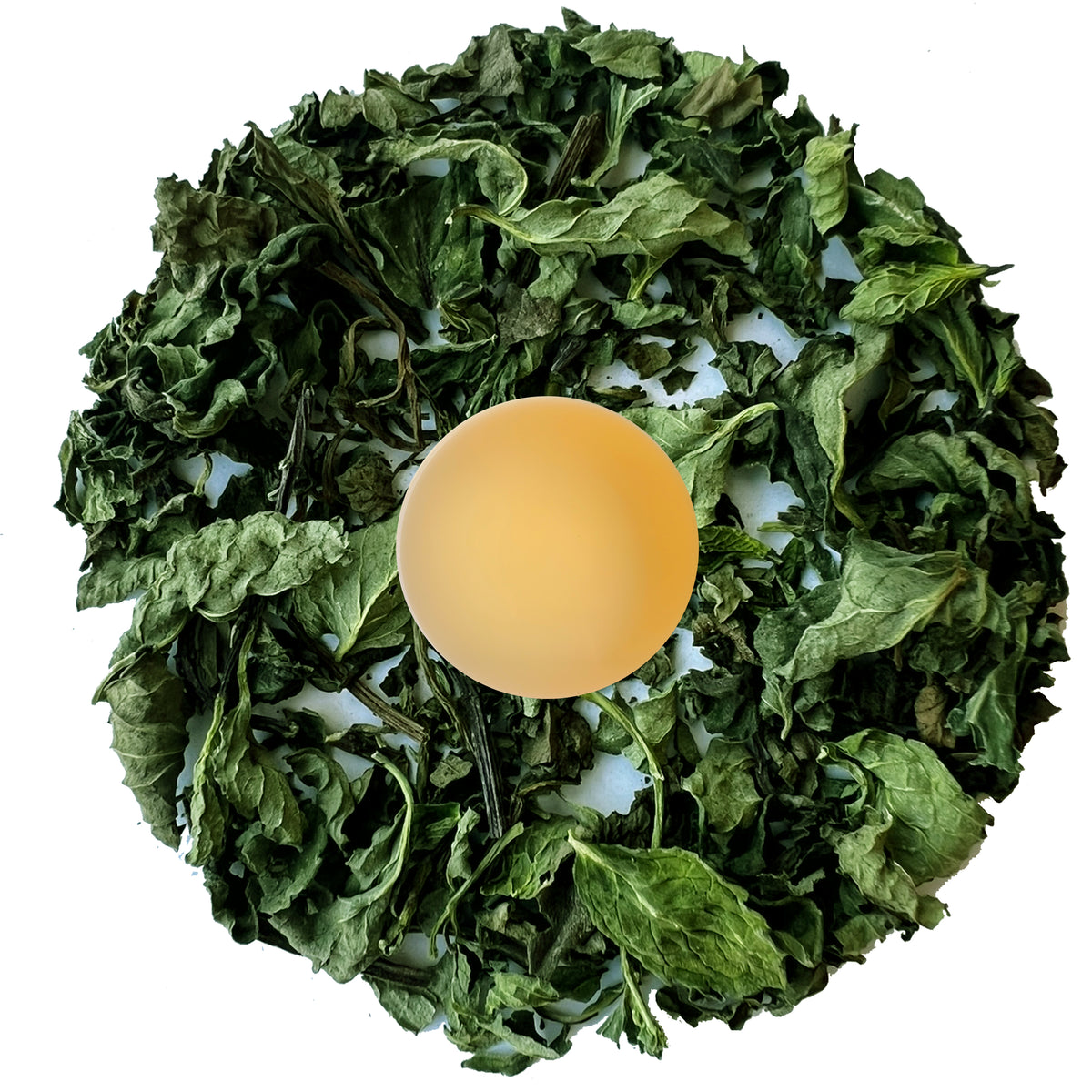
36° Himalayan Spearmint Tea
A single-ingredient loose-leaf tisane with a naturally sweet garden-mint aroma and gentler cooling finish than peppermint.
- 100% loose spearmint leaves
- Naturally caffeine-free
- No black or green tea added
- Suitable hot or iced
- One-time and subscription options

85° Spearmint Lemongrass Herbal Tea
A caffeine-free loose-leaf blend combining gentle spearmint with bright, aromatic lemongrass for a crisp citrus-mint cup.
- Loose-leaf spearmint and lemongrass
- Naturally caffeine-free
- Mint-citrus flavor
- Suitable hot or iced
- One-time and subscription options
Frequently Asked Questions
Is peppermint tea good for your skin?
It is a caffeine-free beverage that contributes fluid, but direct improvements in acne, redness, oil production, fine lines or skin firmness have not been established.
Can peppermint tea clear acne?
No reliable clinical evidence shows that drinking peppermint tea clears acne. Use proven acne care and seek dermatology guidance for persistent or scarring breakouts.
Does peppermint tea reduce oily skin?
Peppermint tea has not been shown to reduce facial sebum production.
Does peppermint tea balance hormones?
No. Peppermint tea is not an established hormone-balancing therapy. Limited studies commonly cited in mint discussions involved spearmint, not peppermint.
How long does peppermint tea take to improve skin?
There is no evidence-based timeline because a skin benefit from drinking peppermint tea has not been clinically demonstrated.
Can peppermint tea treat eczema or rosacea?
No. It has not been established as a treatment for either condition.
Does peppermint tea detox the skin?
No defined “skin detox” effect has been demonstrated. Plain peppermint tea contributes fluid but does not flush acne-causing toxins.
Can I use peppermint tea as a facial toner?
Homemade peppermint tea is not a tested acne toner or sterile skin-care formulation. Sensitive skin may react to fragranced mint ingredients.
Is peppermint tea caffeine-free?
Pure peppermint leaf tea naturally contains 0 mg caffeine. Blends with black, green, white or oolong tea contain caffeine.
Is spearmint the same as peppermint?
No. They are different mint plants with different dominant aromas and flavors. Danfe Tea’s current mint collection is spearmint-forward.
Can peppermint tea worsen reflux?
Some people experience heartburn or digestive discomfort with peppermint or concentrated peppermint products. Stop drinking it if symptoms repeatedly worsen.
Don't know your tea? Just ask.
Meet Chat GP Tea, Danfe Tea's AI tea assistant. Tell it what you like, ask about brewing, compare teas, or discover a Himalayan tea that fits your taste.
Key Takeaways
- Peppermint tea has not been proven to clear acne.
- It has not been shown to reduce sebum or balance hormones.
- Claims about eczema, rosacea, wrinkles and UV protection are unproven.
- Plain peppermint tea contributes fluid and contains no natural caffeine.
- It does not “detox” the skin.
- Peppermint oil research should not be applied to ordinary tea.
- Do not apply undiluted peppermint essential oil to the face.
- Peppermint and spearmint are different plants.
- Danfe currently sells spearmint-forward mint teas rather than pure peppermint.
- Persistent or scarring acne deserves evidence-based care.
Honest ingredients. Refreshing mint. No unsupported promises.
Explore Himalayan Mint Teas
Discover pure spearmint and bright spearmint-lemongrass loose-leaf teas for a naturally caffeine-free hot or iced tea ritual.
Continue Exploring Mint Tea
Sources and Further Reading
- National Center for Complementary and Integrative Health: Peppermint Oil—Usefulness and Safety
- American Academy of Dermatology: What Causes Acne?
- American Academy of Dermatology: Updated Acne Management Guidelines
This article is provided for educational purposes and is not medical advice. Peppermint tea, spearmint tea and Danfe Tea products are foods and beverages and are not intended to diagnose, treat, cure, mitigate or prevent acne, eczema, rosacea, hormonal disorders or any disease. Seek professional care for persistent, painful or scarring skin symptoms. Product availability and purchase options may change; review the current product page before ordering.